
What Are SEO Frameworks? Models + Template
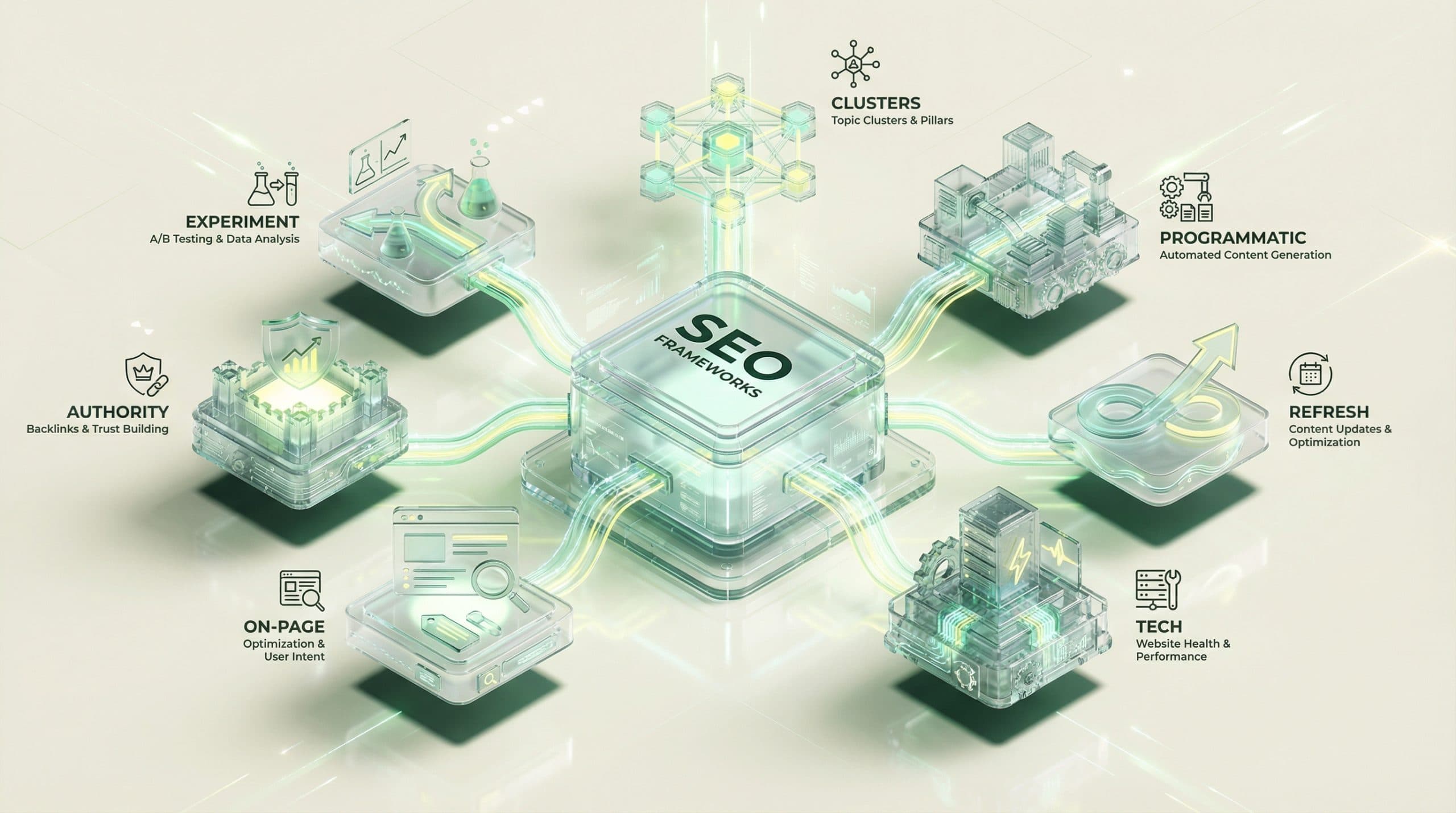
What Are SEO Frameworks? 7 Repeatable Models + a Simple Evaluation Template
Most SEO teams don’t fail because they lack ideas. They fail because execution is inconsistent: work gets stuck in handoffs, priorities change weekly, and nobody can confidently tie actions to outcomes.
An SEO framework solves that by turning “what we should do” into a repeatable method—with clear inputs, steps, outputs, owners, and cadence.
This guide defines SEO frameworks, compares seven common models, and gives you a copy/paste scorecard to choose the right one for your constraints. It also explains the “operations layer” many teams miss—and how an SEO Operating System (what it is and how it works) closes the gap between strategy and results.
What are SEO frameworks? (definition + why they matter)
An SEO framework is a structured, repeatable approach for delivering SEO work from start to finish (inputs → steps → outputs) so multiple people can execute consistently and you can measure progress over time.
Frameworks matter because SEO is not one task—it’s a system of interdependent work: research, content production, on-page optimization, internal linking, technical fixes, publishing, and performance monitoring. Without a shared framework:
-
Quality varies from author to author.
-
High-value tasks get skipped (e.g., internal links, refreshes, validation).
-
Cycle time increases (more rework, more approvals, more context switching).
-
Measurement becomes fuzzy (“traffic went up” vs. “this workflow drove this outcome”).
A good framework makes SEO operational: repeatable, teachable, and improvable.
SEO framework vs SEO strategy vs SEO operating system
These terms get mixed up. They’re related but not the same.
Strategy = choices
SEO strategy is where you decide what you’re doing and why:
-
Which segments and topics you’re targeting
-
Which outcomes matter (pipeline, revenue, leads, retention, etc.)
-
How you’ll compete (depth, differentiation, speed, authority)
Strategy is directional. It’s the set of bets.
Framework = repeatable method
An SEO framework is how you execute those bets repeatedly:
-
What triggers work (e.g., keyword gap, decay alert, crawl issue)
-
Who owns each step
-
What “done” means (deliverables + acceptance criteria)
-
How often it runs (weekly, monthly, quarterly)
Frameworks reduce variation and increase throughput.
Operating system = connected workflows + measurement (closing the Operations Gap)
An SEO Operating System is the execution environment that makes frameworks easier to run at scale: connected workflows, fewer manual handoffs, and consistent reporting so you can see what actions drove results.
This is where many teams hit the Operations Gap: the framework exists in a doc, but the work lives across disconnected tools, spreadsheets, and inbox approvals. An operating system closes that gap by turning your framework into a runbook that’s easier to execute, track, and improve.
The 7 most common SEO frameworks (and when to use each)
Most teams use more than one framework, but they usually have one primary motion (the main driver of growth) and a couple of supporting motions (maintenance + compounding gains).
1) Topic cluster framework (pillar + cluster)
Best for: building topical authority, organizing content, and improving internal linking.
How it works: You publish a pillar page (broad topic) and supporting cluster pages (subtopics) that interlink to build relevance and coverage.
-
Inputs: audience pains, keyword/theme research, existing content inventory
-
Outputs: pillar + clusters, internal linking map, update plan
-
Cadence: monthly cluster publishing + quarterly pillar refresh
Use it when: you have multiple related topics to cover and need a scalable content architecture.
2) Programmatic SEO framework (templates + scalable pages)
Best for: high-coverage, long-tail acquisition where pages share a repeatable structure.
How it works: You define page templates driven by structured data (e.g., categories, locations, attributes) and generate many useful pages with consistent SEO rules.
-
Inputs: dataset, taxonomy, template requirements, QA criteria
-
Outputs: template(s), generated page set, monitoring and quality checks
-
Cadence: initial build + ongoing QA and iteration
Use it when: you can create genuinely helpful pages at scale without thin content or duplication issues.
3) Content refresh framework (decay detection → update → reindex)
Best for: teams with an existing content library and plateauing growth.
How it works: You identify decaying pages (drops in impressions, rankings, clicks, conversions), update them with intent alignment and freshness, then request recrawl/indexing where appropriate.
-
Inputs: performance data, content inventory, SERP changes
-
Outputs: refreshed pages, updated internal links, change log
-
Cadence: weekly triage + monthly refresh batches
Use it when: you already have traffic but it’s unstable or slipping.
4) Technical SEO hygiene framework (crawl/index/render → fixes → validation)
Best for: reducing technical drag that suppresses all other SEO work.
How it works: You run a recurring technical audit loop: identify issues, prioritize by impact, implement fixes, validate, and monitor.
-
Inputs: crawl data, index coverage signals, logs (if available)
-
Outputs: prioritized backlog, validated fixes, monitoring checklist
-
Cadence: monthly audit + weekly high-priority fixes
Use it when: indexing, rendering, speed, or site architecture issues are limiting performance.
5) On-page optimization framework (intent → structure → entities → internal links)
Best for: improving rankings and conversion on high-value pages.
How it works: For each target query, you align with intent, improve information structure, strengthen topical/entity coverage, and reinforce internal links.
-
Inputs: target query + variants, SERP analysis, internal linking opportunities
-
Outputs: updated brief, optimized page, internal link updates
-
Cadence: continuous; prioritize by business value
Use it when: you have pages ranking on page 2/3, or pages with traffic that don’t convert.
6) Authority building framework (digital PR + linkable assets + distribution)
Best for: competitive spaces where links/mentions are a gating factor.
How it works: You create linkable assets (original data, research, tools, definitive guides), pitch them to relevant publications, and distribute through owned channels.
-
Inputs: story angles, asset plan, outreach lists, distribution calendar
-
Outputs: earned links/mentions, referral traffic, improved authority signals
-
Cadence: campaign-based (monthly/quarterly)
Use it when: your best content is strong but can’t break through due to low authority or stiff competition.
7) SEO experimentation framework (hypothesis → test → measure → rollout)
Best for: mature teams that need compounding gains and clear learning loops.
How it works: You run controlled experiments (templates, internal links, titles, content blocks), measure impact, and roll out winners systematically.
-
Inputs: hypothesis backlog, test design, measurement plan
-
Outputs: test results, decision log, rollout playbooks
-
Cadence: biweekly/monthly test cycles
Use it when: you want repeatable lifts and better forecasting, not just “publish more.”
How to evaluate an SEO framework
Framework selection is less about “best practice” and more about “best fit.” Use this process to choose a framework that matches your constraints and goals.
Step 1: Define the job-to-be-done and constraints
Write one sentence that makes tradeoffs explicit:
Job-to-be-done: We need to achieve ______ (outcome) in ______ (timeframe) with ______ (team/resources) while constrained by ______ (e.g., technical debt, approvals, low authority, limited publishing access).
Then list your top constraint (pick one):
-
Speed: you can’t ship fast enough
-
Resources: too few writers/SEOs/devs
-
Technical debt: crawling/indexing/architecture issues
-
Authority: you can’t compete in SERPs without links/mentions
-
Measurement: results can’t be tied to actions
Step 2: Score the framework across 6 criteria
Score each candidate framework from 0–5 on the criteria below, then apply weights based on what matters most right now.
-
Impact potential: will this move your primary KPI?
-
Effort: people-hours required to run it well
-
Time-to-value: how quickly you’ll see leading indicators
-
Data requirements: do you have the inputs to run it reliably?
-
Cross-team dependencies: how blocked you’ll be by approvals/dev
-
Measurability: can you attribute outcomes to this motion?
Step 3: Pick a “primary framework” + 1–2 supporting frameworks
Most teams stall when they try to run everything at once. A simple operating approach:
-
Primary framework: the main growth engine for the next 90 days
-
Supporting framework #1: removes friction (often technical hygiene or on-page)
-
Supporting framework #2: compounds value (often refresh or experimentation)
This keeps focus while still maintaining the site and capturing quick wins.
SEO framework evaluation template (copy/paste)
Copy this into a doc, Notion page, or sheet and fill it out for 2–4 candidate frameworks.
Framework profile (inputs, outputs, cadence, owners)
-
Framework name: ______
-
Primary goal: ______
-
Ideal use case: ______
-
Inputs required:
-
Data: ______
-
Tools/systems: ______
-
People/skills: ______
-
-
Workflow steps (high level):
-
Trigger: ______
-
Plan: ______
-
Execute: ______
-
QA: ______
-
Publish/Deploy: ______
-
Measure/Learn: ______
-
-
Outputs (definition of done):
-
Deliverables: ______
-
Acceptance criteria: ______
-
-
Owners (by role):
-
DRI (directly responsible individual): ______
-
Reviewer/approver: ______
-
Contributor(s): ______
-
-
Cadence: weekly / biweekly / monthly / quarterly (choose one) + notes: ______
Implementation checklist (first 30 days)
-
Pick the primary framework and write your “definition of done” for one unit of work (one cluster, one refresh batch, one technical sprint, etc.).
-
Assign a DRI (one person accountable) and name reviewers/approvers.
-
Set cadence (e.g., weekly planning + midweek production + Friday publish).
-
Create a backlog intake rule (what qualifies, how it’s prioritized, what gets rejected).
-
Standardize QA with a short checklist (intent match, structure, internal links, metadata, schema where relevant).
-
Define leading indicators (indexation, impressions, ranking movement, CTR, assisted conversions) and when you’ll review them.
-
Run one complete cycle end-to-end (small scope), document blockers and fixes.
-
Ship a second cycle with improvements based on what you learned.
-
Hold a 30-day retro: keep, change, stop; update the framework doc so it reflects reality.
Common failure modes (why frameworks don’t stick)
If frameworks are so useful, why do they fall apart in real organizations?
The Operations Gap: disconnected tools, manual handoffs, data silos
The #1 issue is operational: the framework is written down, but execution happens across scattered tools and people. Common symptoms:
-
Research in one place, briefs in another, drafts in another, publishing in another.
-
Manual copy/paste between systems introduces errors and rework.
-
Ownership is unclear (“Who’s actually pushing this live?”).
-
Reporting doesn’t connect work shipped to outcomes achieved.
The result: inconsistent throughput and a backlog that never clears.
Velocity breaks: slow production, slow publishing, slow feedback loops
Even good frameworks fail when cycle time becomes too long. Velocity breaks happen when:
-
Content production can’t keep up with the plan.
-
Publishing is bottlenecked (limited access, slow approvals, manual formatting).
-
Measurement is delayed or unclear, so you can’t learn and iterate quickly.
When feedback loops slow down, motivation drops—and the framework becomes “that doc we used last quarter.”
How an SEO Operating System makes frameworks executable at scale
If frameworks are the method, an operating system is the environment that makes the method easier to run—especially when your team grows, content volume increases, and stakeholders multiply.
Unify your stack (single source of truth)
Frameworks depend on shared context: what’s planned, what’s in progress, what shipped, and what happened afterward. An operating system reduces fragmentation so your team isn’t reconciling multiple versions of reality.
Automate your workflow (idea → illustrated → published faster)
The biggest throughput gains usually come from reducing manual steps and handoffs. When workflows are more connected, teams can move from idea to production to publishing with fewer bottlenecks—without sacrificing quality gates.
Measure what matters (tie actions to ROI)
Frameworks stick when teams can see cause and effect: “We shipped X, which led to Y.” An operating system makes it easier to review performance in a unified reporting view and connect activities to outcomes over time.
Go/Organic positions this as an execution layer—an operating system that helps teams operationalize SEO work with connected workflows and a unified dashboard narrative. If you want to see how that looks in practice, start with the Go/Organic SEO Operating System product overview.
CTA: See how an SEO Operating System turns frameworks into repeatable workflows
Next steps: choose a framework, then operationalize it
To move from “framework on paper” to results, keep it simple:
-
Choose one primary framework for the next 90 days.
-
Add 1–2 supporting frameworks that remove friction and compound gains.
-
Run the 30-day rollout checklist and document what breaks.
-
Close the Operations Gap by tightening ownership, cadence, and measurement.
If you want a fast way to evaluate fit and identify operational bottlenecks, you can book a demo to see the workflow and dashboard in action.
CTA: Book a demo to review your current framework and ops gaps
FAQ
What is an SEO framework in simple terms?
An SEO framework is a repeatable method for doing SEO work (inputs → steps → outputs) so different people can execute consistently and you can measure results over time.
What’s the difference between an SEO framework and an SEO strategy?
Strategy is the set of choices (which markets, topics, and goals). A framework is the repeatable process you use to execute those choices (how you research, create, optimize, publish, and improve).
How do I choose the right SEO framework for my team?
Start with your primary constraint (speed, resources, technical debt, authority, or measurement). Then score candidate frameworks on impact, effort, time-to-value, data requirements, cross-team dependencies, and measurability. Pick one primary framework and 1–2 supporting frameworks.
Can I use more than one SEO framework at the same time?
Yes, but avoid running too many “primary” motions at once. Most teams do best with one primary framework (e.g., topic clusters) plus supporting frameworks (e.g., refresh + technical hygiene) on a defined cadence.
Why do SEO frameworks fail in real organizations?
Most failures come from the Operations Gap: disconnected tools, manual handoffs, unclear ownership, and weak measurement. The framework exists on paper, but execution is slow and results aren’t tied back to actions.