
SEO Dashboards vs Execution: Close the Ops Gap
SEO Dashboards vs Execution: Why Reporting Doesn’t Create Growth (and What Does)
SEO dashboards are everywhere: Looker/GA4 views, keyword trackers, weekly scorecards, “visibility” charts. They’re helpful—sometimes essential. But if you’re still missing growth targets, the issue usually isn’t the dashboard. It’s what happens (or doesn’t happen) after the dashboard review.
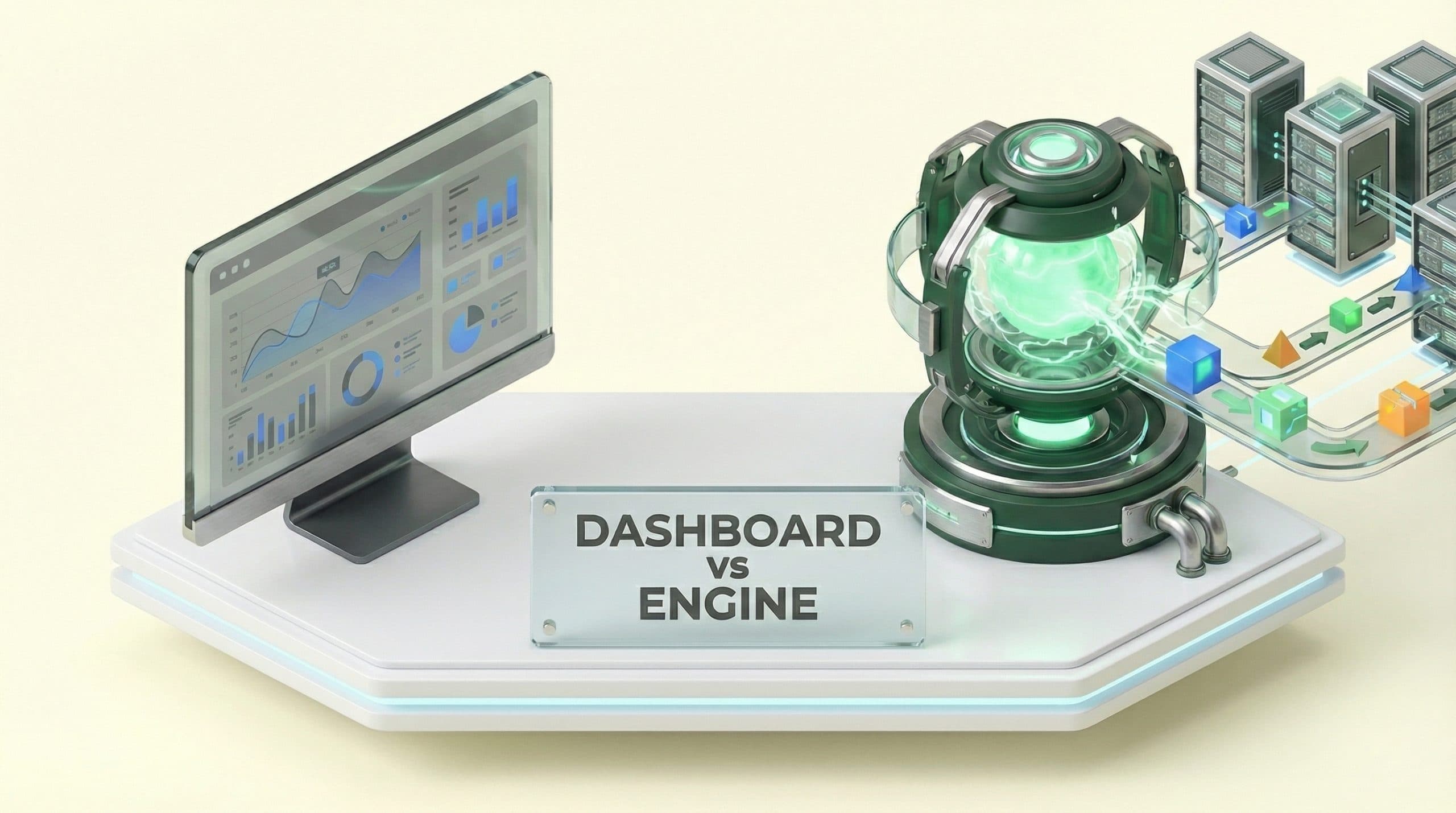
This is the tension behind SEO dashboards vs execution: reporting shows you what changed; execution is the system that reliably ships the changes that cause growth.
That breakdown is exactly what we call the SEO Operations Gap (and why it blocks measurable results): the distance between insights and shipped work—made worse by disconnected tools, manual handoffs, unclear ownership, and slow publishing cycles.
Below is a practical, operator-focused way to diagnose the gap, redesign your dashboard around execution, and build a weekly rhythm that turns reporting into measurable outcomes—without turning this into a “new tools” listicle.
The real problem isn’t dashboards—it’s the gap between dashboards and work
What “SEO dashboards” are good at (visibility, alignment, accountability)
Dashboards shine when they:
-
Create shared visibility across marketing, content, and leadership (one place to see what’s happening).
-
Align priorities (what pages/queries matter this quarter).
-
Support accountability (did we hit the planned targets, and where are we behind).
In other words: dashboards are a great rearview mirror. They can also be a good instrument panel—but only if the organization has an engine that responds to what the instruments say.
What dashboards can’t do (create velocity, remove bottlenecks, ship changes)
Dashboards do not:
-
Write a brief, draft, edit, add visuals, and publish on time.
-
Fix template issues, internal linking, or indexation problems.
-
Turn “insights” into tickets with clear acceptance criteria.
-
Remove cross-team bottlenecks (content → design → dev → SEO → publish).
If your process can’t ship work consistently, more dashboards just create a tighter reporting loop—not a growth loop.
The SEO Operations Gap: where reporting breaks down
The Operations Gap usually shows up as one (or more) of these symptoms.
Symptom 1: Metrics look “busy” but rankings don’t move
You review dashboards weekly. The charts move. The meetings happen. Yet priority pages stall because the work behind the metrics isn’t changing—or isn’t focused.
Common causes:
-
No shipping cadence (publishing and updates happen “when we can”).
-
Work spreads thin across too many URLs/queries at once.
-
Execution is under-measured, so you can’t tell if the bottleneck is volume, quality, or time-to-publish.
Symptom 2: Insights don’t become tickets (or tickets don’t get shipped)
Dashboards produce findings like “CTR is low,” “indexation dropped,” or “these pages are cannibalizing.” But then:
-
No one owns turning the insight into a scoped task.
-
Tickets get created without context (no query targets, no before/after baseline, no definition of done).
-
Work gets stuck in handoffs (waiting on visuals, dev, approvals).
This is why “we need better reporting” is often a misdiagnosis. The real fix is an operating rhythm that forces insights into shipped work.
Symptom 3: Data silos hide cause-and-effect (CMS, ecommerce, webmaster tools)
Even when teams ship changes, they struggle to attribute impact because the evidence is fragmented:
-
Content status lives in the CMS.
-
Revenue proxies live in ecommerce analytics.
-
Indexation and query performance live in webmaster tools.
If those systems aren’t connected, it’s hard to answer the operator’s question: What did we ship, what signal changed, and what outcome followed?
SEO dashboards vs execution: a simple model (Actions → Signals → Outcomes)
To close the Operations Gap, rebuild your dashboard around a causal chain:
-
Actions = what you shipped (controllable).
-
Signals = leading indicators that show search is responding (early feedback).
-
Outcomes = business results and ROI proxies (lagging, but decisive).
Actions (what you ship): content, visuals, internal links, publishing, fixes
Examples of Actions that belong on an execution-first dashboard:
-
New pages published (by cluster and intent)
-
Existing pages updated (what changed, not just “updated”)
-
Internal links added to priority pages (count and source quality)
-
Technical fixes deployed (templates, schema, redirects, canonicals)
-
Visual assets shipped (illustrations, comparison tables, annotated screenshots)
Signals (leading indicators): indexation, impressions, CTR, crawl behavior
Signals are what you watch to validate that Actions are taking effect before revenue catches up:
-
Indexation coverage for new/updated URLs
-
Impressions trend on target queries (especially non-branded)
-
CTR change after title/meta rewrites
-
Crawl frequency on updated sections (are bots revisiting?)
-
Internal link discovery (are priority pages gaining contextual links?)
Outcomes (lagging indicators): qualified sessions, conversions, revenue proxies
Outcomes confirm ROI, but they lag—and they can be noisy. Use guardrails:
-
Qualified organic sessions (segment by landing page group / cluster)
-
Conversion rate for organic landing pages (watch for mix shifts)
-
Assisted conversions where organic starts or supports the journey
-
Revenue proxies (demo requests, add-to-cart, signups, lead quality)
-
Share of demand for priority topics (impressions and top-10 presence)
Case examples + data: what changes when execution is the focus
These are illustrative, experience-based ranges (not promises). The point is to show the operational deltas that dashboards alone don’t create.
Case 1: “Weekly dashboard reviews” vs “weekly shipping cadence”
Reporting mode: A team holds a 60-minute weekly SEO meeting reviewing rankings, traffic, and “top movers.” Action items are vague (“improve these pages”), and the next week looks similar.
Execution mode: The same team keeps a dashboard, but changes the weekly goal to: ship a fixed number of scoped improvements tied to priority URLs.
-
Before: 0–2 meaningful page updates/week; publish cycle often slips.
-
After: 5–12 scoped updates/week (titles/meta, internal links, section rewrites, FAQ additions) plus 1–3 new pages/week.
-
Leading indicator impact: impressions lift appears within ~2–6 weeks on updated URLs; indexation stabilizes for new pages.
What changed wasn’t the dashboard. It was the operating constraint: work shipped per week.
Case 2: Content production bottleneck (brief → draft → visuals → publish)
Reporting mode: Dashboards identify “content gaps,” but production can’t keep up. Visuals and approvals are the bottleneck, so drafts sit unpublished.
Execution mode: The team maps the content workflow as a pipeline and measures throughput and time-in-stage.
-
Before: time-to-publish ~10–20 days; 40–60% of drafts stall before visuals/publishing.
-
After: time-to-publish ~2–7 days; stalls drop as briefs, visuals, and publishing steps become standardized.
-
Signal impact: more frequent publishing and updating increases crawl revisits and accelerates indexation feedback loops.
Dashboards can tell you you’re behind. Execution metrics tell you why and where to fix the flow.
Case 3: Reporting fragmentation (CMS + ecommerce + webmaster tools)
Reporting mode: SEO performance is reviewed in one tool, content status in another, and business outcomes somewhere else. Attribution becomes debate.
Execution mode: Teams create a single view of the causal chain per priority page set: what shipped → what signals changed → what outcomes moved.
-
Before: analysis time is high (multiple exports); confidence is low.
-
After: faster diagnosis (minutes, not hours) and clearer decisions on whether to iterate, expand, or cut.
CTA: If your dashboards are solid but execution is inconsistent, the fastest improvement is installing an operating rhythm that forces shipping. Start a Free Trial of the SEO Operating System.
What to put on an execution-first SEO dashboard (so it drives action)
An execution-first dashboard isn’t “more charts.” It’s fewer metrics, tightly mapped to the Actions → Signals → Outcomes loop.
The 5 execution metrics that predict growth (with definitions)
-
Shipping cadence (per week): number of meaningful changes published (new pages + scoped updates). Track by cluster.
-
Time-to-publish: median days from brief approved → live URL (shows workflow friction).
-
Update coverage on priority URLs: % of priority pages receiving planned improvements this sprint.
-
Internal link coverage: number of new contextual internal links pointing to priority pages (and from which authority pages).
-
Quality control pass rate: % of shipped pages meeting your checklist (on-page basics, intent match, visuals, schema where relevant).
The 5 outcome metrics that prove ROI (with guardrails)
-
Non-branded impressions on priority topics (guardrail: segment by topic/cluster).
-
Top-10 presence for target queries (guardrail: track distribution, not single “average position”).
-
Qualified organic sessions to priority landing pages (guardrail: define “qualified” events).
-
Conversion volume and CVR from organic landing pages (guardrail: monitor mix shifts by page type).
-
Revenue proxy per cluster (guardrail: keep definitions stable for at least 6–8 weeks).
A practical weekly operating rhythm (30–60 minutes)
-
10 minutes: Review shipped work (what went live; what didn’t; why).
-
10 minutes: Check leading signals (indexation, impressions, CTR changes for last week’s work).
-
15–30 minutes: Decide next actions (double down, iterate, or deprioritize).
-
5 minutes: Commit to a ship list with owners and a definition of done.
The key is the meeting outputs a ship list, not “insights.”
How to close the loop: unify stack, automate workflow, measure what matters
To consistently turn dashboards into outcomes, you need an operating system—not just a reporting layer. That doesn’t mean rebuilding everything. It means connecting the minimum set of systems and standardizing the pipeline from idea to publish.
Unify your stack into a single source of truth (what to connect first)
Start with the systems that answer “what shipped” and “what happened in search”:
-
CMS (to track content state, publication, and updates)
-
Webmaster tools (to track indexation and query performance)
-
Ecommerce or conversion events (to tie outcomes to landing pages)
When the stack is unified, you can stop arguing about numbers and start diagnosing causes.
For teams doing this inside Go/Organic, Connectivity Suite integrations to unify CMS and data sources are the prerequisite layer—so reporting is trustworthy and execution doesn’t get blocked by manual exports.
CTA: If your data is fragmented across CMS and reporting tools, unify it first. See how the Connectivity Suite unifies your stack.
Automate the workflow from idea → illustrated → published
Most SEO “execution” failures are workflow failures:
-
Briefs aren’t standardized, so drafts miss intent and require rewrites.
-
Visuals and formatting happen late, delaying publishing.
-
Publishing is manual, so updates batch up and slip.
An execution-first approach standardizes the pipeline and uses automation where it removes the most friction—especially across the steps that slow throughput.
Go/Organic is built around that operational flow: Content Engine, Visual Operations Suite, Publishing Engine, and Velocity Engine™—so teams can move from insight to shipped page improvements consistently (without turning every update into a cross-team fire drill).
Tie shipped work to ROI with a unified dashboard
The dashboard you want is not “SEO performance.” It’s “SEO performance explained.” For each priority cluster or page set, you should be able to answer:
-
Actions: what did we ship in the last 7/30 days?
-
Signals: what changed in indexation, impressions, CTR, and crawl behavior?
-
Outcomes: what happened to qualified sessions and conversion proxies?
That’s why an operating system matters. If you’re evaluating what “good” looks like here, Go/Organic’s SEO Operating System for execution-first growth is designed to close the loop: unify your stack, increase shipping velocity, and connect shipped work to measurable outcomes.
Decision checklist: do you need better dashboards—or an SEO Operating System?
If you answer “yes” to 3+, you’re in reporting mode (not execution mode)
-
We review SEO dashboards weekly, but can’t point to what we shipped because of the review.
-
Insights regularly fail to become scoped tickets with owners and definitions of done.
-
Our median time-to-publish is unpredictable (or consistently over a week for updates).
-
Drafts stall waiting for visuals, formatting, approvals, or publishing access.
-
We can’t easily connect a page update to changes in impressions/CTR/indexation.
-
We spend more time exporting and reconciling data than shipping improvements.
-
We track outcomes, but we don’t track execution metrics (cadence, coverage, cycle time).
Next step: install an execution system (without rebuilding your whole stack)
You don’t have to throw out your dashboards. Keep them—but reposition them as the feedback layer for an execution system that ships changes weekly.
If you want the complete framework for diagnosing and fixing the root causes, revisit the SEO Operations Gap (and why it blocks measurable results) and map your workflow to the Actions → Signals → Outcomes loop.
CTA: Ready to turn reporting into a reliable growth loop? Install an execution system to turn reporting into ROI.
FAQ
Are SEO dashboards useless?
No—dashboards are essential for visibility and alignment. The failure mode is treating dashboards as the work. If insights don’t translate into shipped changes (content, fixes, publishing), the dashboard becomes a reporting loop instead of a growth loop.
What’s the difference between reporting and execution in SEO?
Reporting summarizes what happened (rankings, traffic, conversions). Execution is the operational system that ships changes consistently (from idea → content → visuals → publish → iterate) and connects those actions to leading indicators and outcomes.
What metrics prove SEO execution is working before revenue shows up?
Use leading indicators tied to shipped work: indexation coverage for new pages, impressions growth on target queries, CTR changes after title/meta updates, crawl frequency on updated sections, and internal link coverage to priority pages.
Why do teams with great dashboards still miss growth targets?
Because the bottleneck is usually operational: disconnected tools, manual handoffs, unclear ownership, and slow publishing cycles. Those issues reduce velocity and make it hard to attribute outcomes to actions.
What’s the fastest way to move from dashboarding to execution?
Start by unifying your stack (CMS + key data sources) so reporting is trustworthy, then standardize a weekly shipping cadence with a small set of execution metrics. Once the loop is stable, expand automation and measurement depth.