
Unified SEO Data Platform: Checklist
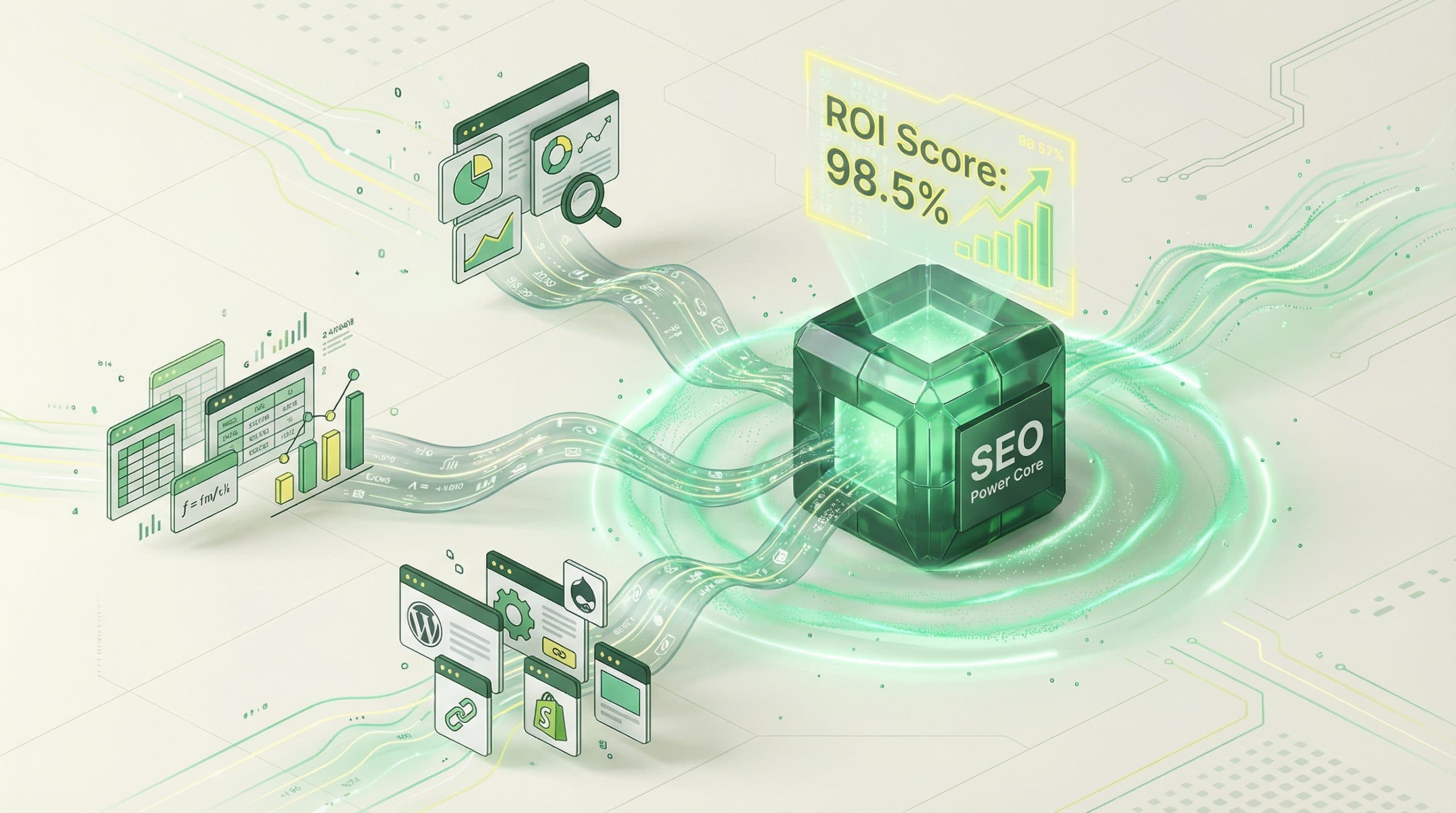
Unified SEO Data Platform Playbook: Prove You Need an SEO OS (Not More Tools)
If you’re a Head of SEO or Growth, you’ve probably felt it: performance is “fine,” but shipping is slow, reporting is fragile, and every win requires stitching together exports, tabs, and screenshots. That’s not an SEO problem—it’s an Operations Gap.
A unified SEO data platform is the category-level answer to that gap: one connected system that ties SEO work (ideas, briefs, drafts, updates, publishing) to outcomes (rankings, clicks, revenue proxies) without constant manual glue.
If you’re deciding whether to buy a platform, add more tools, or lean harder on an agency, start with the broader SEO OS vs tools comparison framework. This article is the proof checklist you can use to justify the move internally and define what “unified” needs to mean for your team.
What a “unified SEO data platform” actually means (and what it replaces)
A unified SEO data platform centralizes SEO-relevant data and connects it to the work that produces results—so you can plan, produce, publish, and measure in one operational system.
-
What it replaces: disconnected point tools, spreadsheet-based tracking, manual reporting decks, and handoffs that live in docs/PM tools/email.
-
What it is not: just “more features in one login.” A true platform closes operational gaps: connectivity, workflow velocity, and measurement.
The problem it solves: the Operations Gap (data silos, manual handoffs, unclear ROI)
The Operations Gap shows up when your team can’t reliably answer, quickly and confidently:
-
What did we change? (and where is it documented?)
-
What shipped? (and why did it take that long?)
-
What worked? (and what should we do more of next?)
When those answers require exports, one-off dashboards, or memory, you don’t have a strategy problem—you have an operational system problem.
The outcome: a single source of truth that connects actions → results
The goal is a single source of truth where the work and the data live together—so stakeholders trust reporting, teams ship faster, and you can tie operational inputs (publishing cadence, refreshes, optimizations) to outcomes.
At Go/Organic, that “SEO OS” framing is built around three practical pillars: unify your stack, automate your workflow, and measure what matters—so SEO becomes a repeatable growth engine instead of a collection of tools and heroics.
The proof checklist: do you have a unified platform problem (or just a process problem)?
Use this section as an internal diagnostic. If you check 5+ boxes across Data, Workflow, and ROI, you likely need a unified platform (or you’ll keep paying the “tool sprawl tax” in time and trust).
Data proof (single source of truth)
Can you answer “what changed?” without stitching exports and tabs?
-
You rely on spreadsheets to track which URLs were updated and when.
-
You can’t quickly see the relationship between a content change and a performance shift.
-
Your reporting requires pulling data from multiple tools every week/month.
-
Two stakeholders can look at the “same” report and disagree on the numbers.
If/then rule: If your team can’t audit changes and outcomes in one place, your “data stack” is actually a manual process.
Are performance metrics tied to specific content and workflow actions?
-
Your content calendar is separate from performance tracking.
-
You can’t group results by action type (new publish vs refresh vs optimization).
-
You don’t have consistent definitions for KPIs leadership trusts (e.g., clicks, conversions proxy, pipeline proxy, revenue attribution approach).
If/then rule: If performance isn’t connected to actions, you’ll struggle to justify headcount, budget, and prioritization.
Workflow proof (velocity from idea → published)
Count handoffs and tools touched per article
Pick one recently published piece and count:
-
How many people touched it? (SEO, writer, editor, designer, PM, approver, publisher)
-
How many tools were involved? (brief doc, research tool, content editor, visuals tool, PM, CMS, analytics, reporting)
-
How many times did it “go dark”? (waiting for approvals, waiting for visuals, waiting for publish)
If/then rule: If a single article requires 6–10 tool touches and multiple invisible waits, adding another point tool won’t meaningfully increase shipping velocity.
Identify bottlenecks: briefs, drafts, visuals, approvals, publishing
-
Brief bottleneck: briefs are inconsistent, late, or not tied to performance goals.
-
Draft bottleneck: writing cycles are long because inputs are scattered.
-
Visual bottleneck: “We need visuals” becomes a multi-day cross-team request.
-
Approval bottleneck: stakeholders review in different places; feedback conflicts.
-
Publishing bottleneck: final steps are manual, error-prone, or owned by a different team with different priorities.
If/then rule: If publishing is a bottleneck, operational tooling (workflow + publishing engine) matters as much as “SEO features.”
CTA: Use the SEO OS vs tools comparison to validate your best path.
ROI proof (measurement that leadership trusts)
Can you attribute outcomes to operational inputs (updates, refreshes, publishing cadence)?
-
You can’t answer which effort type produced the most impact last quarter.
-
Your team debates what “worked” because results aren’t mapped to executed work.
-
Leadership asks for ROI and you respond with rankings/screenshots instead of an operational story tied to business KPIs.
If/then rule: If you can’t tie outcomes to actions, you’ll default to opinions—and SEO becomes vulnerable during budget scrutiny.
Do you have a unified dashboard that survives stakeholder scrutiny?
-
Dashboards change depending on who built them.
-
Monthly reporting is a fire drill.
-
Stakeholders don’t trust the data (or don’t look at it).
If/then rule: If stakeholders don’t trust reporting, the operational cost shows up as slow decisions, constant rework, and reduced investment.
The decision framework: SEO OS vs disconnected tools vs agency
Use this to decide the “shape” of your solution. The goal isn’t to buy the biggest platform—it’s to close the specific gaps causing drag.
When more tools are enough (and when they aren’t)
-
More tools are enough if you have a strong operational process already, a reliable reporting system, and the only gap is one specific capability.
-
More tools aren’t enough if the real issue is cross-tool fragmentation: inconsistent briefs, long cycle times, manual publishing, and reporting that can’t connect work to outcomes.
If/then rule: If the pain is “we can’t execute and measure consistently,” point tools will likely increase complexity faster than they increase results.
When an agency is the right call (and the hidden cost of the handoff)
-
An agency is a good fit when you need strategic expertise, temporary execution capacity, or you’re rebuilding a program.
-
Hidden cost: every handoff adds latency (briefing, revisions, approvals) and can weaken measurement clarity if reporting isn’t tied to your internal system of record.
If/then rule: If you already have in-house expertise but can’t ship fast or prove ROI, the bottleneck is often operations—not strategy.
When an SEO Operating System wins (speed + consistency + measurable results)
An SEO OS wins when you need to operationalize SEO end-to-end: connect your stack, standardize workflow, ship faster, and measure results in a way leadership trusts.
Use this page to compare an SEO Operating System vs disconnected SEO tools when these are true:
-
You need a single system to coordinate content operations (not just “SEO research”).
-
You want to reduce time lost to manual handoffs (briefs → drafts → visuals → approvals → publishing).
-
You need reporting that ties operational actions → outcomes without spreadsheet wrangling.
Requirements checklist for buying a unified SEO data platform
Before you evaluate vendors, define requirements that map to your actual constraints. These checklists also double as procurement-ready acceptance criteria.
Unify your stack: integration requirements (CMS + data sources)
CMS connectivity (e.g., WordPress) and publishing workflow
-
CMS integration: Confirm your primary CMS is supported.
-
Ecommerce support: If relevant, confirm store/CMS specifics.
-
Publishing workflow: Define who publishes, how approvals work, and what “done” means (SEO checks, formatting, visuals, internal links).
Data connectivity (what’s connected today vs needed next)
-
Current sources: List what you use today (e.g., Bing Webmaster Tools, Google Search Console).
-
Connection status: Validate what’s actually connected vs what’s on the roadmap.
-
Future-proofing: Write down “next sources” you’ll need as you scale (additional sites, markets, or CMSes such as Shopify—availability may vary by platform).
Automate your workflow: velocity requirements
From idea → optimized draft → visuals → publish (minutes, not days)
Define the workflow you want to standardize. A unified platform should reduce tool switching and unclear ownership.
-
Ideation: Where topics/URLs live; how priority is decided.
-
Content production: How briefs and drafts are created, reviewed, and updated.
-
Visual operations: How visuals are requested, produced, and attached to content.
-
Publishing: How content moves into the CMS with fewer manual steps.
Go/Organic positions this as an operating system with connected components (Connectivity Suite, Content Engine, Visual Operations Suite, Publishing Engine) designed to reduce cycle time and operational overhead—without relying on fragile “process glue.”
Measure what matters: reporting requirements
Unified dashboard that connects ops actions to ROI
-
Define trusted KPIs: Choose the metrics leadership will accept (and document definitions).
-
Map actions to outcomes: Require the ability to analyze results by action type (publish, refresh, optimization) and by URL/content cluster.
-
Governance: Decide who owns measurement, how often it’s reviewed, and how it drives prioritization.
Procurement tip: Ask vendors to demo a “before/after” workflow where a specific action (e.g., refresh 10 URLs) can be reviewed later alongside performance changes—without manual spreadsheet reconciliation.
Narrative you can use internally: the business case in 6 sentences
The “before” story (fragmentation, manual work, slow shipping)
-
Our SEO stack is fragmented across tools and spreadsheets, so we spend significant time stitching data and coordinating handoffs.
-
Because work and measurement live in different places, it’s hard to answer “what changed” and “what worked” with confidence.
-
That creates slow shipping velocity, inconsistent execution quality, and reporting that stakeholders don’t fully trust.
The “after” story (single system, higher velocity, clearer ROI)
-
A unified SEO data platform gives us a single system that connects our stack, standardizes workflow from idea to publish, and reduces manual operations.
-
With actions tied to outcomes in one dashboard, we can make faster prioritization decisions and justify investment with credible measurement.
-
Net: we increase content velocity, improve consistency, and make SEO a measurable growth engine instead of a collection of tools.
Next step: compare your options and price the path forward
Use the comparison to validate fit
Take your checklist results (Data, Workflow, ROI) and validate which solution shape closes the gaps fastest. The most efficient next step is to use the SEO OS vs tools comparison framework and evaluate against your requirements list—not against a generic feature grid.
Sanity-check pricing against tool sprawl and agency retainers
Unification is rarely “free,” but neither is tool sprawl: it shows up as ongoing labor cost, slower shipping, and weaker attribution. If you’re ready to align budget with an operational system, review Go/Organic pricing for an SEO Operating System and compare it against your current tools + internal time + agency retainers.
CTA: Review pricing to replace tool sprawl with one operating system.
FAQ
What is a unified SEO data platform?
A unified SEO data platform centralizes SEO-relevant data and connects it to the work that produces results—so teams can move from fragmented tools and manual reporting to a single source of truth that supports faster execution and clearer ROI.
How do I know if I need a unified platform instead of adding another SEO tool?
If you repeatedly stitch data across tools, can’t reliably tie actions (publishing, updates, refreshes) to outcomes, or lose weeks to handoffs from idea to publish, you likely have an operations problem that more point tools won’t fix.
Is an SEO Operating System the same as an all-in-one SEO suite?
Not necessarily. An SEO Operating System is positioned around closing the Operations Gap—unifying stack connectivity, automating workflow velocity, and measuring what matters—rather than simply bundling features.
What should I evaluate first when buying a unified SEO data platform?
Start with (1) stack connectivity requirements (CMS + data sources), (2) workflow automation needs from idea to publishing, and (3) measurement requirements—especially whether you can connect operational actions to ROI in a unified dashboard.
Can a unified SEO data platform replace an agency?
It depends. Agencies can be ideal for strategy or execution capacity, but a unified platform reduces the friction and reporting ambiguity that often comes from handoffs. Many teams use a platform to make in-house and/or agency work measurable and repeatable.