
Why 96.55% of Content Gets No Google Traffic
“
Why 96.55% of Content Gets No Traffic From Google (And How to Fix the Operations Gap)
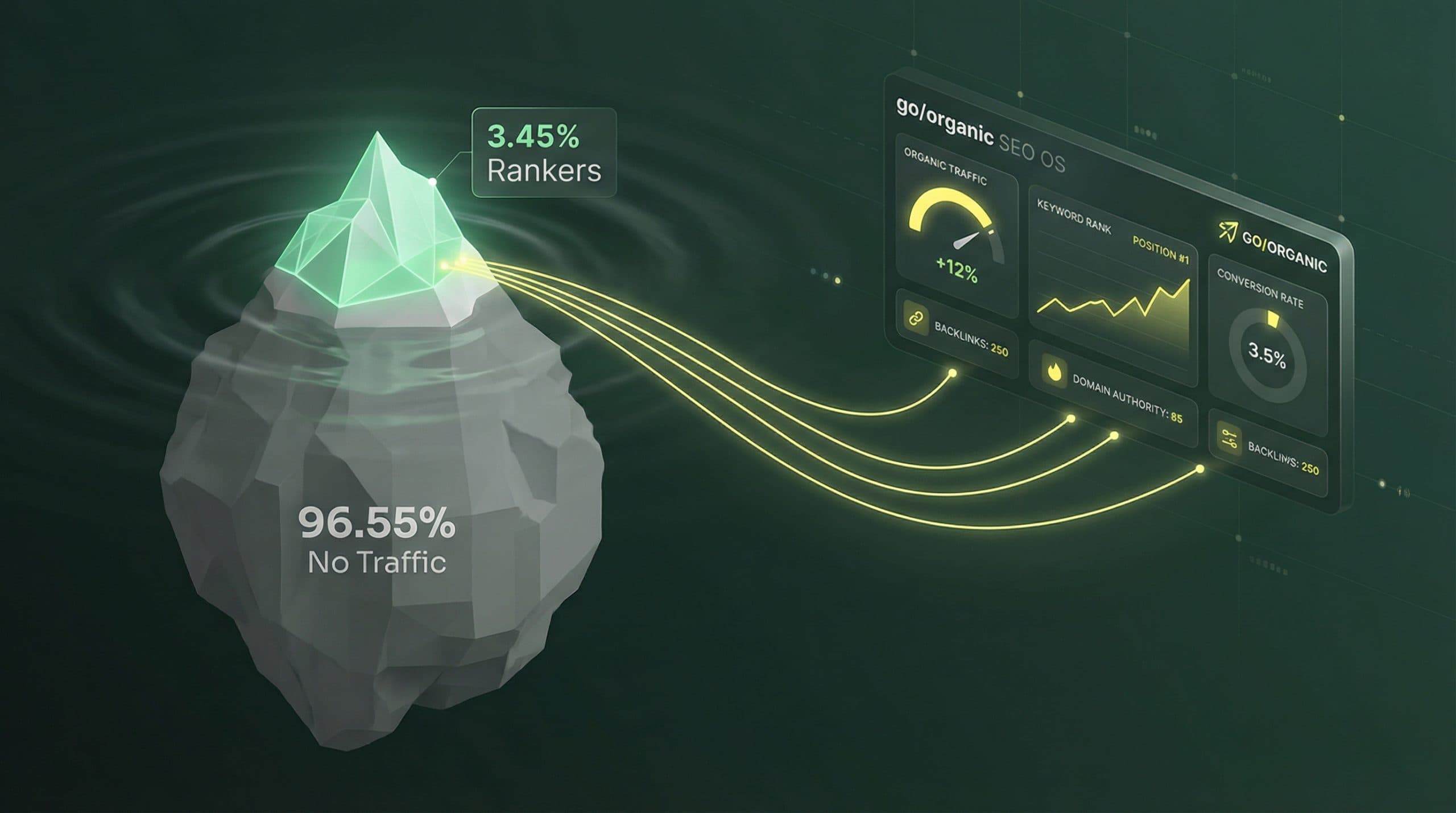
The headline statistic—96.55% of content gets no traffic from Google—shows up in large-scale SEO research often enough that it’s become a shorthand for a frustrating reality: most pages never earn meaningful organic visibility.
But the most useful takeaway isn’t the exact percentage. It’s the pattern behind it: teams publish at scale, yet the chain from research → production → publishing → measurement breaks in predictable places. That break is the Operations Gap.
If you want the full operating model that closes the gap (without creating QA chaos), start with the Velocity Blueprint for scaling content without QA chaos. This article is the “why it happens” and “how to diagnose it” companion piece—so you can stop adding to the backlog of pages that never rank.
What does “96.55% of content gets no traffic from Google” actually mean?
When studies cite a number like 96.55%, they’re typically analyzing very large sets of pages and then measuring how many receive organic search visits (often over a defined time window).
That means two things can be true at once:
-
Many pages get literally zero organic visits.
-
Many more get traffic so small it may as well be zero for a business (a handful of visits that don’t convert and never grow).
“No traffic” vs. “no meaningful traffic” (and why the difference matters)
Operationally, “0 visits” and “5 visits/month” often share the same root cause: the page never found a stable path to ranking.
For content teams, the difference matters because “no meaningful traffic” creates a dangerous illusion of progress. The page is indexed, it exists in analytics, and it feels “done”—but it doesn’t justify the production cost, and it crowds your roadmap with low-leverage work.
Why this stat shows up in large datasets (long tail + competition + decay)
In big datasets, most pages sit in the long tail: niche topics, weak differentiation, minimal internal links, and little authority support. Add natural content decay (SERPs change; competitors update; intent shifts), and it’s normal for a large portion of pages to drift toward zero over time—unless there’s an iteration loop that pulls winners up and repairs near-winners.
The 7 most common reasons content gets zero Google traffic
If your team is publishing consistently but results are inconsistent, you’re usually dealing with one (or more) of these failure modes.
1) It never gets indexed (or gets deindexed later)
You can’t get traffic from Google if Google can’t—or won’t—keep the page in its index. Common operational causes include:
-
Accidental
noindextags, canonical misconfiguration, or blocked crawling. -
Orphan pages (no internal links), so discovery is slow or unreliable.
-
Low perceived value (thin/duplicative pages) leading to delayed indexing or eventual deindexing.
2) The topic has no search demand (or demand is misread)
Teams often confuse “this is important to us” with “people search for this.” Demand gets misread when:
-
You rely on a single keyword estimate instead of validating query variants and SERP reality.
-
You target ultra-specific phrasing that no one actually uses.
-
You pick topics that belong in sales enablement or lifecycle content, not search acquisition.
3) Search intent mismatch (informational vs. commercial vs. navigational)
A page can be well-written and still fail if it doesn’t match what the SERP is rewarding. Common mismatches:
-
Writing a “what is” explainer when the SERP is dominated by category pages or tools.
-
Publishing a product-led page when the SERP is clearly informational guides.
-
Targeting broad keywords with a narrow page (or vice versa).
Intent mismatch is especially common when content briefs are created without a consistent SERP review step.
4) The page has no unique value (thin, duplicative, or “same as everyone”)
“Helpful content” isn’t a vibe—it’s evidence. Pages underperform when they don’t give Google (and readers) a reason to choose them over the top results. Typical gaps:
-
No original examples, process, frameworks, or point of view.
-
Repackaging common advice without adding specificity.
-
Multiple pages on your site competing for the same query (cannibalization).
5) Internal linking is missing (Google can’t find or prioritize it)
Internal links do two jobs: discovery and prioritization. Without them, even good content can sit unseen. Common issues include:
-
New posts published without being linked from relevant hubs or high-authority pages.
-
Clusters that exist “in theory” but not in actual site architecture.
-
Anchor text that’s generic (e.g., “click here”) instead of meaningfully descriptive.
6) The site lacks authority for the query (and the content can’t break in)
Some SERPs are brutally competitive. If you’re trying to rank for queries dominated by established sites, you may need to earn your way in via:
-
More specific angles (long-tail entries that still have demand).
-
Stronger topical depth (supporting cluster content that builds relevance).
-
Authority signals (including links) targeted to the pages that can realistically win.
The mistake is treating “authority” as the default explanation before you’ve confirmed indexing, intent match, and internal linking.
7) The content workflow breaks before results (publish-and-pray, no iteration loop)
This is the most common “at scale” failure: content is produced and shipped, but there’s no repeatable mechanism to learn and improve. Symptoms:
-
No scheduled post-publish review, so near-winners never get upgraded.
-
No clear ownership of fixes (SEO says “update it,” editorial says “we shipped it”).
-
No connection between performance data and next sprint planning.
The hidden cause: the Operations Gap between content creation and measurable results
Most teams don’t fail because they “don’t know SEO.” They fail because the workflow that turns SEO inputs into outcomes is fragmented.
Disconnected tools and handoffs slow velocity and reduce quality control
When research, briefs, writing, editing, publishing, and measurement live in separate places with inconsistent standards, you get:
-
More cycle time (and more context switching).
-
Inconsistent SERP/intent checks.
-
QA gaps (missing internal links, wrong canonicals, weak differentiation).
And the longer the cycle time, the less likely you are to iterate quickly enough to turn a page into a winner.
Data silos obscure what’s working (and what to fix next)
If performance insights aren’t tied to the content inventory and workflow, teams struggle to answer basic questions:
-
Which pages are close to ranking and should be updated first?
-
Which topics consistently underperform and should be deprioritized?
-
Which content patterns correlate with results (format, depth, internal link position, etc.)?
Without a single source of truth, “content strategy” becomes opinion-driven and slow.
A practical diagnostic: how to tell which failure mode you’re in
Use this sequence to diagnose zero-traffic pages quickly. The goal is not to audit everything—it’s to identify the dominant constraint so you can fix the right thing first.
Step 1: Confirm discoverability (crawlability + indexing checks)
-
Is the URL indexable? Check for
noindex, incorrect canonical, blocked robots rules. -
Is it internally linked? Ensure at least one relevant, crawlable page links to it (ideally a hub/cluster page).
-
Is it in the index? If it’s not indexed, don’t optimize the copy yet—fix discovery/indexing first.
Step 2: Validate demand and intent (keyword-to-page fit)
-
Is there real demand? Validate the query family, not just one keyword string.
-
Does the SERP match your page type? Compare your format to the top results (guide, list, landing page, template, etc.).
-
Can you state intent in one sentence? If you can’t, the page likely can’t either.
Step 3: Evaluate competitiveness and differentiation (why you deserve to rank)
-
What do top results have that you don’t? Specificity, examples, fresher updates, clearer structure, stronger entities.
-
What is your “proof”? A process, checklist, original perspective, or real-world constraints—not just rewritten definitions.
-
Are you competing with yourself? Look for overlapping pages and consolidate when appropriate.
Step 4: Check internal link pathways (hub/cluster alignment)
-
Is there a clear hub? Link the cluster to a relevant pillar/hub and ensure the hub links back.
-
Are links placed where they matter? Add contextual links in body copy, not only in “Related posts.”
-
Is anchor text descriptive? Use anchors that reflect the topic the destination page covers.
Step 5: Establish a measurement loop (what you’ll change based on data)
-
Set review windows: 7 / 14 / 30 days after publish (or after major updates).
-
Define the hypothesis: “If we align intent + add internal links, impressions should rise.”
-
Define the action: What you’ll change if the hypothesis is wrong (revise angle, consolidate, improve differentiation, etc.).
How to prevent “zero-traffic content” with a repeatable operating system
The fix isn’t “write better” in the abstract. It’s installing an operating model that makes the right work repeatable.
Unify your stack (single source of truth for content + performance signals)
At minimum, you need a unified content inventory that connects:
-
What you published (topic, intent, brief, target query set).
-
How it’s supported (internal links, hub alignment).
-
How it performs over time (visibility, engagement proxies, outcomes you track).
This is how you move from “content calendar” to “content system.”
Automate your workflow (reduce cycle time without QA chaos)
Automation should compress cycle time and standardize quality gates (SERP checks, internal linking, on-page requirements, and post-publish reviews). The goal is fewer dropped handoffs and fewer “we forgot to…” mistakes.
If your team needs a way to systematize this end-to-end, consider the Velocity Engine to automate the workflow from idea to published content as the operational layer—so your process is repeatable even as volume increases.
Measure what matters (connect operational actions to ROI)
Measurement is not just reporting. It’s a feedback loop that changes what you do next. That means:
-
Tracking which actions correlate with lifts (intent alignment updates, link improvements, consolidation, refresh cadence).
-
Prioritizing updates based on proximity to impact (near-winners first).
-
Creating a rhythm where performance drives the next sprint backlog.
A simple “Velocity” publishing checklist (use this before you hit publish)
Use this checklist to reduce the probability of creating another zero-traffic page. It’s intentionally operational—meant to be applied every time.
Topic + intent lock (one sentence: who is this for and what should they do next?)
-
Audience: __________
-
Problem: __________
-
Search intent: informational / commercial / navigational
-
Next step (desired action): __________
SERP reality check (what type of page is winning and why?)
-
Top results are mostly: guides / lists / tools / category pages / templates
-
Common sections you must match: __________
-
Angle you can own: __________
Differentiation proof (original data, examples, process, or POV)
-
One unique element we provide (not in top results): __________
-
One concrete example (scenario, template, or decision rule): __________
-
One “show your work” section (steps/checklist): __________
Internal links mapped (pillar + money path + related clusters)
-
Link to the relevant hub/pillar: added
-
2–5 contextual links to related clusters: added
-
Anchor text is descriptive (not generic): confirmed
Post-publish iteration plan (what you’ll review at 7/14/30 days)
-
Day 7: indexing confirmed; early impressions; internal link placement check
-
Day 14: query mix and intent match; adjust headings/sections to fit SERP patterns
-
Day 30: evaluate competitiveness; improve differentiation; consider consolidation if cannibalizing
Decision rule: If a page is indexed but has low impressions after 30 days, treat it as a targeting/intent problem. If it has impressions but low clicks, treat it as a SERP packaging problem (title, angle, match to winning format). If it has clicks but no traction beyond, treat it as a value/differentiation problem.
CTA: If you want this checklist embedded into a repeatable workflow (so it happens every time), see how Velocity Engine turns your workflow into a repeatable growth engine.
When to use a product vs. a pilot to close the gap
Different teams get stuck in different places. Choose the next step based on whether your bottleneck is execution consistency or organizational alignment.
If you need speed + consistency: implement Velocity Engine
If you already have a clear strategy but the team can’t execute it consistently—briefs vary, QA is inconsistent, internal links get missed, and iteration doesn’t happen—your issue is operational throughput. A workflow system that standardizes gates and connects inventory to performance is often the fastest path to reducing zero-traffic output.
If you need change management: run a 30-day pilot
If the harder problem is alignment—multiple stakeholders, unclear ownership, competing priorities, or disagreement on what “good” looks like—start with a guided implementation. A 30-day pilot to install a measurable content operating system is designed for teams that need proof, process, and buy-in before scaling.
CTA: If your team needs alignment plus measurable lift, book a 30-day pilot to close the Operations Gap and prove ROI.
Summary: the stat is real—but it’s fixable with the right system
-
The “96.55%” number is a useful warning: publishing without a system creates a graveyard of pages that never rank.
-
Most zero-traffic pages fail due to predictable operational failure modes: indexing, demand, intent, differentiation, internal links, authority, and lack of iteration.
-
The durable fix is closing the Operations Gap—unifying how you plan, ship, and improve content based on measured feedback.
FAQ
Is it true that 96.55% of content gets no traffic from Google?
The exact percentage depends on the dataset and methodology, but large-scale studies consistently show that most pages receive little to no organic traffic. The useful takeaway isn’t the precise number—it’s that “publish more” without a system usually creates a backlog of pages that never rank.
Does “no traffic” mean the content is bad?
Not necessarily. Zero traffic often comes from operational issues (not indexed, weak internal linking, unclear intent, no differentiation, or no iteration loop). Good writing can still fail if the page isn’t discoverable, aligned to demand, and supported by a measurable workflow.
What’s the fastest way to diagnose why a page gets zero Google traffic?
Start with discoverability (can Google find/index it?), then validate demand and intent (is the query real and does the page match the SERP?), then assess competitiveness/differentiation, and finally check internal links and iteration cadence.
How long should I wait before updating a page that isn’t getting traffic?
If the page isn’t indexed, don’t wait—fix that immediately. If it’s indexed but not ranking, review at 7/14/30 days with a clear hypothesis (intent mismatch, weak internal links, insufficient differentiation, or authority gap) and make targeted updates rather than rewriting blindly.
Is the solution just to build more backlinks?
Backlinks can help, but they’re not a universal fix. Many pages fail before authority even matters—because they’re not indexed, not internally linked, or not aligned to the SERP’s intent. Close those gaps first, then decide where authority-building is actually required.
“